The Name Jar

The Name Jar by Yangsook Choi
Multicultural/International


When Unhei moves from Korea to America, she feels insecure about her hard-to-pronounce Korean name. She decides she might want to change her name, so the students in her class help her think of new names. In the end, Unhei realizes that she likes her own name best, and even though she thought everyone would make fun of it, they all like it too.

This book has a theme of acceptance, making it a good story to use to teach acceptance and the importance of being kind. The multicultural element would help to make students in a diverse classroom feel at ease. This book would be great for a read aloud and would provide great discussion about these topics. There is also a point in the book where Unhei is unsure about how to introduce herself to her classmates since she is embarrassed about her name. This would be a good point to stop and practice making predictions.

Choi, Y. (2001). The Name Jar. New York, NY: Alfred A. Knoff.

Would YOU Join the Fight?

The Revolutionary War Begins - Would YOU Join the Fight?
By Elaine Landau
Non-fiction


VOKI: http://www.voki.com/pickup.php?scid=7518067&height=267&width=200

Landau, E. (2009). Would YOU Join the Fight? Berkeley Heights, NJ: Enslow Elementary.

Island of the Blue Dolphins

Island of the Blue Dolphins by Scott O'Dell
Historical Fiction/Chapter Book/Newberry Medal


Island of the Blue Dolphins is the story of a young Indian girl who gets left alone on her island. While waiting for someone to return to her, she keeps herself safe by building shelter and weapons, and hunting for her own food. She is left alone for many years, struggling to survive on her own, while forming relationships with wild animals to keep herself from being lonely.

This book helps students expand their horizons and realize how different other worlds are. There is a strong female character who does a lot of things that men 'should' do, such as hunting and making weapons. Even though these things are forbidden among women of her tribe, she does what she needs to do to survive. A huge theme in this story is survival, making it interesting and exciting to read. There is also a lot of conflict/conflict resolution and problem solving. This book would be great for talking about conflict resolution. Although this is fiction, it is based on a true story. There is a history standard (3.H.2) dealing with historical narratives. While this isn't exactly a historical narrative, it does offer a look into someone else's life, and helps the reader gain a new perspective.

O'Dell, S. (1960). Island of the Blue Dolphins. New York, NY: Dell Yearling.

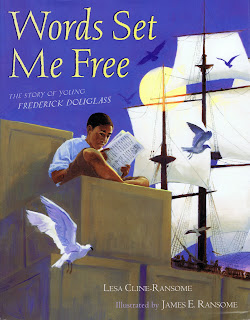
Words Set Me Free

Words Set Me Free - The Story of Young Frederick Douglass
By Lesa Cline-Ransome
Illustrations by James E. Ransome
Non-fiction - Biography


This is the story of Frederick Douglass's childhood, but more specifically, how he learned to read while in slavery. The book ends with what seems to be a happy ending with a successful escape from slavery, but on the last page there is an author's note with a short biography of the rest of Douglass's life. The book is non-fiction, but there aren't many non-fiction structures in the book, aside from a timeline on the last page. The book is written in story form like any other picture book.

There are two social studies standards I found that apply to this book:

3.H.2.2 - Explain how multiple perspectives are portrayed through historical narratives.
5.C.1.4 - Understand how cultural narratives reflect the lifestyles, beliefs, and struggles of diverse ethnic groups.

Both involve reading texts such as this and gaining a new perspective on a historical event. This is extremely important, especially with this issue of slavery. I think this is a great text to use with kids because it tells a tale of slavery from a kid's point of view, making it much more relatable than a textbook version of the same story. This helps students see the story of slavery from a more personal viewpoint, giving them more of an opportunity to relate the story to themselves and think about how something like this would affect their lives.

Cline-Ransome, L. (2012). Words Set Me Free. New York, NY: Simon & Schuster.

Rules

Rules by Cynthia Lord
Realistic Fiction/Disabilities/Chapter Book/Newberry Honor


This book is about a 12 year old girl who has an 8 year old brother with autism. The narrator and main characer, Catherine, has a list of rules that she gives to her brother, David, to help him understand things he has trouble with due to his disability. Throughout the book, Catherine befriends a boy who is unable to speak or walk, and learns to accept others as well as herself.

This book is one that I felt I could do a lot with academically. When looking through the standards, I found 4 that I would consider using for this:

RL.4.1 - refer to details and examples in a text when explaining what the text says explicitly and when drawing inferences from the text. This story has quite a few places where inferences can be made, especially about how the narrator is feeling and why she feels that way.

RL.4.2 - determine the theme of a story from details in the text; summarize the text and RL.4.3 - describe in depth a character, setting, or event in a story, drawing on specific details in the text. There are a lot of issues addressed in this story - autism, disabilities, and the difficulties associated with disabilities for starters. There are also themes of friendship, family, parental neglect, and acceptance. These are themes and issues that students can relate to and discuss rather easily.

RL.5.6 - Describe how a narrator's point of view influences how events are described. One reason I loved this book so much was because the narrator was so candid, and the reader was able to hear a lot of her deep, personal thoughts. If the book was narrated from a different point of view, we wouldn't have so much information about her personal thoughts. This is a good text to address the importance of point of view and think about what might change if someone else tells the story.

Lord, C. (2006). Rules. New York, NY: Scholastic Press.

The Lightning Thief

The Lightning Theif by Rick Riordan
Book One of Percy Jackson and the Olympians
Modern Fantasy/Chapter Book


This book is about a 12 year old boy, Percy, who finds out that he is not a normal child, but a demigod and the son of Poseidon. When Zeus's lightning bolt goes missing, Zeus believes that Percy has stolen it, and Percy goes on a quest with two of his friends to find it. The book is full of interesting creatures and has many mythological references and connections.

This book is the first in a series, making it yet another book perfect for the standard RL.3.9 - compare and contrast the themes, settings, and plots of stories written by the same author about the same or similar characters. Standard RL.4.4 - determine the meaning of words and phrases as they are used in a text, including those that allude to significant characters found in mythology (e.g., Herculean), is also suitable for this book, since it is based on Greek mythology. This would most likely be a book I would use for reading groups or in the classroom library.

Riordan, R. (2005). The Lightning Thief. New York, NY: Hyperion Books for Children.


Artemis Fowl

Artemis Fowl by Eoin Colfer
Modern Fantasy/Chapter Book


This book is about a young genius named Artemis Fowl who finds and decodes a book, leading him to the discovery of a secret fairy world. He kidnaps a fairy, Holly, and holds her for ransom, demanding fairy gold. The fairies and other creatures retaliate, attempting to rescue Holly. The story is written in 3rd person and focuses on Artemis's side of the story, as well as the fairies'. The story involves a multitude of made-up creatures and customs, creating a completely different world which is very complex.

Because of the narration, I could easily use this book to cover standards involving learning about point of view, including RL.4.6 - compare and contrast the point of view from which different stories are narrated, including the difference between first- and third-person narratives. I could also address the standard RL.3.9 - compare and contrast the themes, settings, and plots of stories written by the same author about the same or similar characters. Since this is the first in a series, it would be  a perfect one to use for this standard, especially if a student had a special interest in the book. I think this would also make a great Lit Circle book, and due to its intriguing content, would be an interesting add to the classroom library.

Colfer, E. (2001). Artemis Fowl. New York, NY: Hyperion Books for Children.